



Design
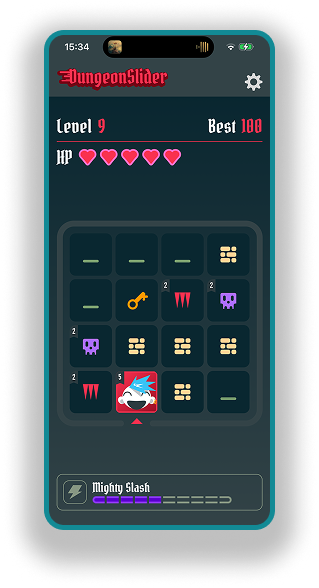
Everything started in Figma — game board layout, character design, cell illustrations, UI screens. Since there was no visual reference for this kind of mechanic, the design phase was largely about inventing a visual language from scratch: how do you make a sliding grid feel like a dungeon? SVG assets were the medium, Figma was where every answer got worked out before touching the code.
Development
Built with Claude Code through an experimental, mechanic-first loop: design something in Figma, describe it, get it running, play it, break it, iterate. No framework, no build step — deliberately lean so the feedback loop stayed as tight as possible. Claude wrote the code; I played the game and decided what came next.
What did I learn
That game design is mostly about removing things. Every mechanic that seemed interesting in theory created friction in practice — the fun came from constraint, not from adding more. I also learned that a tight feedback loop between design and playable build is more valuable than any amount of upfront planning: you only know if something works when you can actually play it.
Stack
Vanilla HTML / CSS / JS. SVG vector assets. Installable as a PWA.